
Can you feel it?
Change is in the air, and hope no longer feels like wasted energy. In the US. In Brazil. Across Europe.
As the results of the US mid-terms came in, one of the things that caught my attention was the money spent trying to influence those results. The total cost of the campaign is estimated to be just below $12 billion, with $446 million of that apparently coming from the obscenely deep pockets of Elon Musk.
It’s worth keeping that figure in mind next time you hear there’s no money to support the arts.
It’s all about priorities.
And right now, our creativity doesn’t feel like it’s anyone’s priority at all. But what happens when governments do decide to encourage and support creative talent?
In his excellent book Making Art And Making A Living, Mason Currey writes about the New Deal, the US government’s response to the Great Depression, in which the state invested huge sums to get people working again, mainly building essential infrastructure.
After someone pointed out that artists were also starving, President Roosevelt decided to include them in the scheme. “Surely there must be some public place where paintings are wanted,” he commented.
The Federal Art Project launched in August 1935, and 5000 artists signed up for it immediately.
A tsunami of creativity was unleashed.
Within months, more than 1000 artists were on its payroll in New York alone making paintings, sculptures, or works of graphic design at home or in their studios; or researching, planning, and executing public murals and posters at locations throughout the city.
“For their efforts, they collected checks for $23.86 a week,” Currey writes. “This was a decent wage; according to US Bureau of Labor statistics, it was on par with the average starting salary of a worker in automobile manufacturing.
“For artists who had barely been scraping by, standing in breadlines for their only meal of the day.. it was a life-changing windfall.”
The Project gave artists stability.
Many of them could focus fully on their work for the first time. They could afford to eat, drink and socialise. Most importantly, as they all had to show up to the same place to collect their cheques, it created community that lasted long after the Project itself ended.
Many of the artists – painters, sculptors, but also poets, writers, composers – that emerged from this scheme and scene are still celebrated today: Jackson Pollock, Frank O’Hara, Grace Hartigan, Willem de Kooning, Lee Krasner, Helen Frankenthaler, John Cage.
I have no idea of the value the art they created, but I’d imagine it is now worth millions, if not billions more than the state invested in it. It’s also impossible to put a price on the cultural capital that was created.
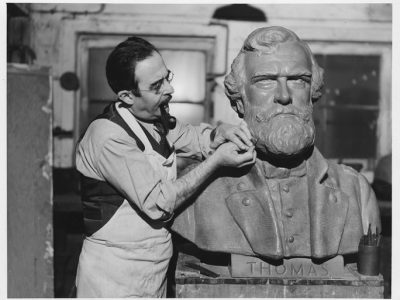
The Smithsonian has an archive of over 18,000 photographs documenting artists at work and the murals, statues and other works produced during the Federal Art Project. (The picture above is just one of them.) New York is still seen as a global centre for the arts, attracting creatives from all over the world. And Roosevelt’s scheme played a part in that.
Thatcher’s children
In 80s Britain, the Conservative government unwittingly launched a similar scheme. The Enterprise Allowance Scheme was designed to help people launch their own business – and get them off unemployment benefits.
Participants were paid £40 a week for a year, providing they could get £1000 business loan, produce a basic business plan and attend an induction day. There was very little oversight once you’d been accepted.
Almost everyone of my age working in a creative field got a year of government subsidy this way, with very few strings attached. It wasn’t as altruistic as the Federal Arts Project, and was generally viewed as a way of manipulating soaring unemployment figures. But it gave us room to experiment, play, try new things while having a basic income.
Not everyone became a success.
But you’ll be hard-pressed to find an artist, band, writer, designer, club promoter, photographer, stylist, comedian, actor or director from my generation who didn’t take advantage of the Enterprise Allowance Scheme. From Pulp and Happy Mondays to Lee Bowery, Creation Records to Tracy Emin and Jeremy Deller, it helped countless creatives survive while they found their way.
Partly because of this, the arts and popular culture thrived in Britain throughout the 80s and 90s. In taxes from the most successful pop stars, fashion mavens and visual artists alone, it must have paid its way. But again, the cultural capital created is harder to measure, but so important
“I don’t think they ever intended to support the arts, but it ended up being quite successful,” artist Rachel Whitread told the Guardian 40 years later.
That was then, this is now.
At a time of seemingly endless cuts to arts budgets, such schemes might feel impossibly utopian. Applying for a grant is now like a full-time job in itself, with no guarantee of funding at the end of it. And it’s hard to imagine governments supporting struggling creatives when there’s apparently no money to pay teachers, nurses or carers properly – or even fix potholes.
And yet.. there’s Ireland. At the start of 2026, the Irish government launched Basic Income for the Arts, a scheme that guarantees 2000 artists, musicians and other creatives €325 (£283) a week for three years.
Initially designed as an emergency measure to help creatives through the pandemic, the scheme was such a success that they are continuing it. A cost/benefit analysis showed that for every Euro spent, €1.39 was generated via arts spending and increased productivity, or saved via decreased claims for other benefits.
We can’t predict what will emerge from this experiment.
The next U2, Sinead O’Connor or Westlife, perhaps. A new James Joyce, WB Yeats or Sally Rooney. A new wave of fashion designers, architectural innovation, or visual art.
But it’s far more likely to be something we couldn’t have expected at all, something we didn’t even know we wanted or needed until it was there. And it will make Ireland – and the world – a richer place.
Because art is important.
Music, film, performance brings people together, heals division. It’s hard to hate someone when you’ve danced next to them, laughed together, sang along to a song you both love.
Arts, songs, stories help us understand what is wrong with the world, and express our anger about it. But they also help us imagine something better.
One thing is for sure: the problems we’re facing right now won’t be fixed by building more data centres, or giving more tax breaks to tech billionaires. The solutions will come from research, science, ideas – from human ingenuity and creativity.
Surely that’s worth supporting?


What do you think?