
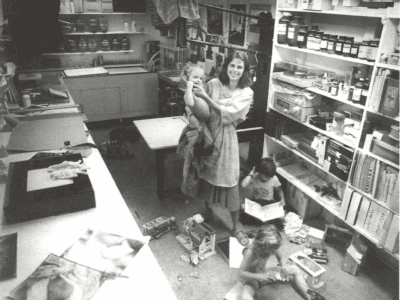
Sally Mann’s guide to a creative life
In her teens, Sally Mann decided she wanted to be an artist. By the time she was 19, she had quit college, announcing in a pompous letter to her parents that “I don’t need a goddamn BA.. All I want to do is work with that goddamn camera.”
In her book Art Work, she shows some of the pictures she was making, at the time of this grand declaration. They were dreadful, she cheerfully points out. As almost anyone’s early work is.
Nonetheless, she persisted. For years, there was little recognition, and even less money. But she had found her calling, and she carried on despite all the obstacles. Now she is celebrated, her work collected and shown in museums worldwide.
Her entertaining book mixes letters, lists and photos with great anecdotes and sharp, often funny observations about the creative life, and what it takes to be an artist.
Here are the lessons I took from it.
Talent is over-rated.
The more you work at it, the more skilled you get.
There are no shortcuts. Just do the work. And lots of it.
Luck plays a huge part in any success story.
A show in a college cafe led to a museum owner buying a print. A chance encounter with another passenger on Mann’s first ever plane trip turned into a friendship with a wealthy patron. Seeking out a collector of rare early cameras led to the gift of a lens she used for years.
Yet all her examples of luck also involve her being open, curious, willing to risk rejection. She staged her own shows. Chose to sit next to an interesting-looking stranger on a plane, and strike up a conversation. Asked strangers for help.
Luck is something you can create if you stay open, take risks, ask for what you need.
Rejection is part of the job.
It is hurtful, frustrating, mortifying. And there’s no way of avoiding it.
Mann shares a story of a rejection by a New York gallery that is so painful and needlessly cruel that it bought tears to my eyes. But the only way through is to just keep trying, keep making new work.
Find the others.
Many of the letters Mann shares in the book were written to her friend and fellow artist/photographer Ted Orland. They met at a photography workshop run by Ansel Adams, and shared their daily struggles, their triumphs, their blocks and supported each other throughout their careers. His side of the correspondence eventually formed the basis of Art And Fear, a classic book about creative process co-written with David Bayles.
Art thrives on community. We all need support, inspiration, people to challenge our ideas and introduce us to new ones. Find the others. Be willing to be honest and vulnerable. Help and encourage each other. This takes time and energy. But it is so worthwhile.
Make your art no matter what.
We all have busy lives, other responsibilities to juggle. And conditions will never be perfect. So find a way, and just do it.
“People make art everywhere,” Mann writes. “They have made it in caves and on the sides of subway cars and hunched over a prison cot writing on toilet paper. They do it when they are exhausted, discouraged; they make their work in spite of not having the time or resources, never mind a computer or a studio. And they make it in the moments cobbled together from a day just as jam-packed as your day is, as you plug yourself into your soul-destroying day job or juggle a baby on your hip while packing the school lunches..”
Make the time you need.
No one will give it to you. It won’t spontaneously appear. Life is chaotic. And artists have to deal with this fact just like anyone else. They have to create structure, take the time they need – and protect it, fiercely.
“The measure of artistic success is not money; it is time.. knowing what I have to do, every hour of every day, and every week of every month is what allows me to schedule, yes schedule, creativity.
“It doesn’t drift down and lightly settle upon us like a gauzy visitation from the muse. You have to clear a well-lit and GPS coordinated landing strip for it.”
Copy. But then repeat until you make it your own.
We all have influences. In time, our work will hopefully influence others.
But first, we have to develop our own voice and style. That takes time, effort – and a lot of bad work, before you get to the work, the style, the story that is uniquely yours.
So keep going. Keep finishing, and putting your best work out there. Your themes, obsessions, style and voice will gradually emerge.
Looking for pictures is like looking for mushrooms.
You spend a long time rooting about in the undergrowth, unable to see them. But once you do see the mushroom – or the image you want, the right words, melody, idea – you find them everywhere.
Mann tells the story of a trip to Qatar, where she was disappointed that the desert didn’t look as pristine as she’d imagined it: much of it was strewn with litter, abandoned cars and debris. But then she realised that this ruined landscape, made ugly by human carelessness, was the image she was looking for. She just hadn’t seen it.
It never stops being difficult.
There’s a point when you forget how hard it was to do your early work. You forget the doubts and fear, the failures and the striving.
Now, that work looks confident. It has a style, a point of view. Perhaps it’s acclaimed, collected. And far from making life easier, you might start to doubt that you’ll ever do anything as good again.
Control, and when to let go of it.
You need to have control of your medium, your skills. Which takes persistence and practice.
You also need to know when to let go of control. When to let the idea, the moment, the feeling, the channel itself through you.
You can control what work you put out into the world; you can’t control how others perceive or understand it.
On censorship.
Mann’s work can be controversial, and it has been censored. By gatekeepers, by politicians chasing headlines. And by herself. Sometimes she has regretted this; other times, she thinks it was necessary.
We should all feel free to explore whatever we want in our work. But we also need to be sensitive to the needs of others, and alert to our own assumptions and prejudices when deciding what we publish or show.
This dialogue between what we explore, what we keep, and what we release into the world is an essential part of creative work, and it is never fixed and done. As the world evolves and changes, so should we.
Talent, passion, the will to do it better
Persistence has its own rewards.
“Each time we do better, even if it’s incrementally, not only do we improve on a molecular level, but our desire and motivation to try again increases commensurately.. A passion for mastery, and the recognition and rewards that follow each improvement, however minor and individual, almost guarantee a greater future investment in the effort; a self-fuelling internal combustion engine within each of us.”
Sally Mann’s Art Work: On The Creative Life is published by Penguin. If you buy it on Amazon using this link, a few pennies go from Jeff Bezos’s bulging wallet to my less weighty purse, to help pay for the costs of running this site. If you prefer to support your local bookshop, that’s brilliant too!



What do you think?