
Creative blocks come to all of us at times.
When the ideas just won’t come, what often works for me is a combination of Morning Pages, rest, reading, play dates, going for walks, and pottering about playing music while going though my notebooks and accumulated piles of papers, books and magazines. That usually unearths something, an idea to get me back into flow.
But perhaps you’re not blocked at all. Perhaps the ideas won’t come because they’re simply not ready yet. You’re still in the crucial early stage of creativity that many of us feel we should be able to skip: the exploration phase.
This is the part of creative work that from the outside can look a lot like doing nothing. Indeed, it can even feel like that from the inside, if you don’t expect it, allow time and space for it, and you instead try to push yourself back into ‘productive’ work too quickly.
This is the time to go wide.
Just follow your curiosity and your interests with no particular agenda or result in mind. It looks a little different for all of us, but it often includes visiting museums, libraries, archives and interesting or inspiring places. Reading, and looking at art/photography books. Going for day-trips or long walks with only your thoughts for company. Allowing yourself to fall down rabbit holes where you research random subjects for no real reason except that you’re interested in them.
Depending on your medium, it might involve doodling or making rough sketches; taking your camera out just to see what you see; listening to music outside your usual genres or eras and improvising to them; meeting interesting friends and contacts and seeking out stimulating talks and conversations; playing about with discarded art materials, words, riffs; or simply day-dreaming.
Even when you’re in the middle of a project and in full flow, it’s worth making some space in your work week for this kind of playful, seemingly pointless exploration.
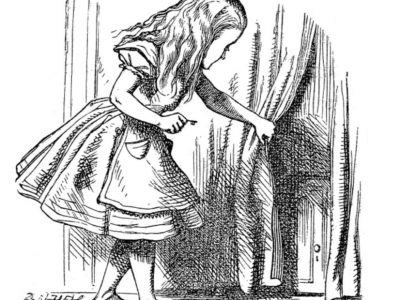
Curiouser and curiouser.
Psychologists call this kind of open, wide exploration divergent thinking. I used to see it as my dreamy, pottering about period. On my harsher days, I would think of it as that useless time after finishing a big project when I wasted precious work hours, and couldn’t seem to focus properly on anything.
But I’ve come to see that it’s a necessary part of the creative process. The more you fight it, the longer it takes to get something new off the ground. So now I give in to it, and enjoy it.
And as I get older I realise that divergent thinking – all those rabbit holes you fall down, those false starts and dead ends – aren’t wasted at all. Especially if you take notes of your random thoughts, about what resonates with you or interests you, or archive those sketches, photographs, riffs.
They’re all seeds, the germs of ideas. And given time, many of them will combine with other fragments and ideas you’ve ingested and left to ferment, and grow into something surprising.
Everything has its cycles and seasons.
Winter is a time of natural rest; spring is when we sow seeds for future harvest. Farmers can’t get ahead by doing this early; they have to wait for the weather, the light, the conditions to be right or they won’t get a harvest at all.
You won’t get bread to rise unless you add the yeast, then leave the dough to prove. And you won’t write your next book, play or film, your next album, find a new creative direction or start an interesting new project without allowing some time – guilt-free – for exploration and divergent thought.
The fear that many of us have is getting stuck in this phase, of never getting back to making our work. It’s important that you are exploring, and seeking out new and interesting things, not just vegging out in front of daytime TV. But it’s also important to trust the process, and believe that something new will unfold.
Just stay curious, and explore.
Send your inner critic off on a sabbatical, if you can.
Let your curiosity be your guide, and notice those sparks of joy, those moments when you get so absorbed in what you’re examining that time just flies. Follow the clues, and slowly, certain ideas, images, beats will start to tug at you.
You’ll research or experiment more narrowly. And you’ll decide on a direction to pursue. Or you’ll get a joyful flash of inspiration when a few of these random and unconnected things you’ve been exploring somehow join together to form an idea, concept or project that excites you, and you know what you want to do next.
This rarely happens when you’re at work.
That’s why pushing on through is rarely effective. Inspiration tends to come in the shower, on a walk, when you’re doing something completely different. It often feels sudden, spontaneous. But your subconscious has been quietly processing all the new inputs you’ve given it while you’ve been exploring, leading up to that flash of insight.
Once you have it, it’s time to shift to much more concentrated mindset that psychologists call convergent thinking.
You eliminate distractions, instead of giving into them. You simplify your idea, and often narrow down the scope until it feels like something you can execute and deliver.
Then you focus. And you begin.
A final note:
The illustration above is one of John Tenniel‘s brilliant 1865 engravings for Alice In Wonderland. You might also be interested in the full version of that old saying about nosiness killing our feline friends:
“Curiosity killed the cat,
But satisfaction brought it back.”




What do you think?